Community Dream Circles
In-Person Community Dream Circles are created and facilitated by Lanie Bergin,
Founder & Program Director Expressive Arts Institute of Oregon.
These gatherings are designed as imaginal containers—spaces where communities are invited to attend to the dreamworld together, within the lived context of their shared experience. Dreams are approached not as personal material to be analyzed, but as living images that move through individuals, relationships, and the collective field.

Two Ways This Offering Is Available
-
In-person gatherings, based on Lanie Bergin’s Attending to the Dreamworld series.
This is a general offering that allows for one-off dream circles to be offered either publicly within your community or for a closed group. The Attending to the Dreamworld offering is a women-centered space.
If you’re looking for an all-gender option, we’d love to work with you through the Customized Dream Circles offering.
These gatherings provide an introduction to Attending to the Dreamworld as a communal and expressive practice. Participants may bring dreams, images, fragments, or simply curiosity. Sharing a dream is always optional.
Pricing Model: Sliding Scale
Public Community Dream Circles are offered on a sliding scale to support accessibility and sustainability.
Sliding scale reflects:
Access to financial resources
Ability to pay without hardship
Support for the ongoing work of the Center for Dreaming Arts
Participants are invited to choose the level that feels appropriate for their circumstances. No explanation is required.
-
Community-Specific, Customized Dream Circles, By Request Only
We offer Virtual or In-Person Format
These circles are custom-designed in response to a particular community, organization, or group. Lanie works in dialogue with the requesting group to shape a gathering that is appropriate, ethical, and aligned with the community’s intentions and context.
Well-suited for:
Community organizations and nonprofits
Schools and educational settings
Families and intergenerational groups
Affinity groups and collectives
Closed communities navigating change or conflict.
Pricing
For closed groups or community-specific offerings, group rates are available and determined based on:
Group size
Length of gathering
Preparation and customization required
Travel and material needs
Once a request is approved, a private Acuity registration link can be created and shared directly with participants.
The Inquiry Process
To inquire, please complete the intake form below. All requests are reviewed with care, and Lanie Bergin will follow-up to explore alignment, scope, and next steps.
Rooted in the core practices and principles of the Center for Dreaming Arts, each circle is shaped with care and responsiveness to the community’s needs, questions, and moment in time. The work honors dreams as carriers of meaning, affect, and movement—calling forth reflection, listening, and relationship rather than interpretation or solution.
The arc of a Community Dream Circle may draw from contexts such as:
Social norms and cultural conditioning
Societal crisis and collective uncertainty
Conflict resolution and relational repair
Family systems and intergenerational dynamics
Thresholds, transitions, and times of change
Rather than working on dreams, participants are invited to work with them—allowing images, sensations, and themes to unfold through expressive and relational engagement.
What to Expect
Expressive Engagement & Dream Attending Practices
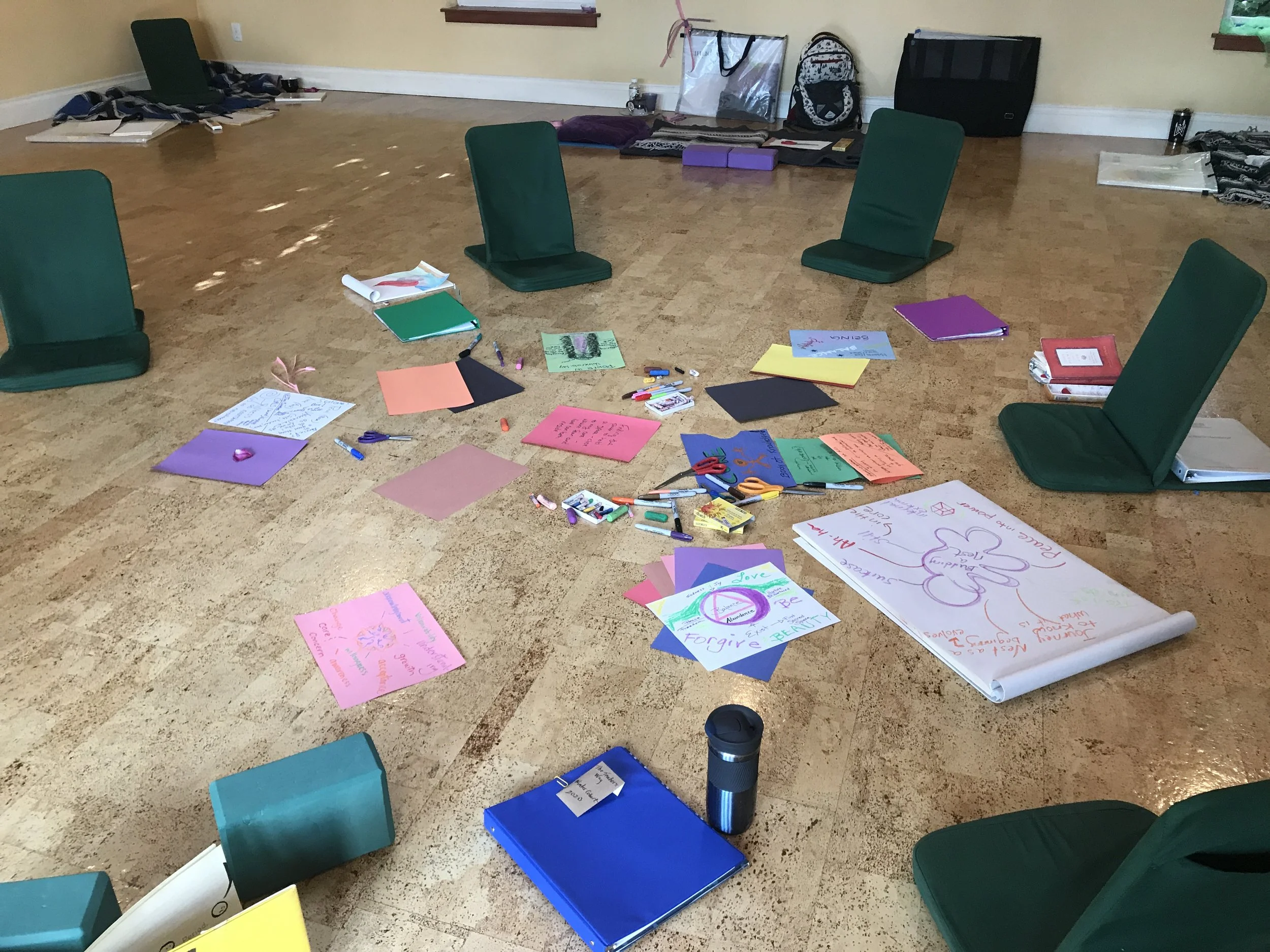
Community Dream Circles draw from expressive arts practices as articulated through the Center for Dreaming Arts. The emphasis is on process rather than product and experience rather than explanation.
Participants may engage in:
Attending to the Dreamworld Practices: Gentle approaches to staying close to dream images, gestures, atmospheres, and affects without interpretation or symbolic decoding.
Expressive Arts Engagement: Invitations may include drawing, movement, simple sound or voice, writing, or working with found materials—allowing dreams to be met through the body and imagination rather than language alone.
Relational & Reflective Dialogue: Structured listening practices that support resonance, mirroring, and shared reflection while honoring personal boundaries and consent.
Image-Based Inquiry: Working with images as autonomous presences—asking what they want, how they move, and what relationships they seek—rather than what they “mean.”
Attending to Affect & Atmosphere: Noticing shifts in mood, tone, sensation, and relational field as meaningful aspects of the dreamworld.
No artistic skill or prior experience with dreamwork is required. All practices are invitational and adaptable.
Dream Circle Inquiry Form
All requests are reviewed with care, and Lanie Bergin will follow-up to explore alignment, scope, and next steps.
Community Dream Circles invite us to remember that dreams do not belong to us alone. They move between us—asking for attention, relationship, and care. These gatherings offer a place to listen together.